An LLM's take on Israeli politics
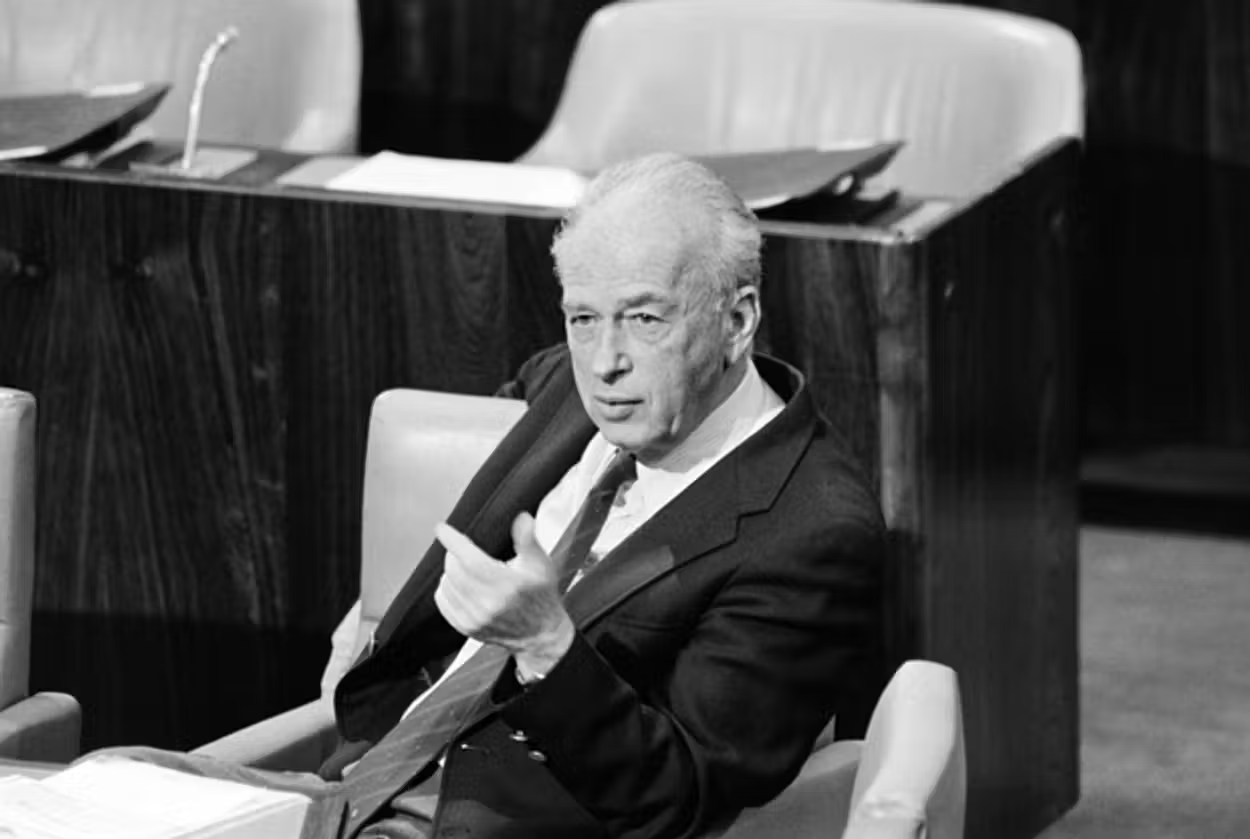
Yitzhak Rabin speaking in the Knesset, 1986
Yitzhak Rabin speaks in the Israeli Knesset, 1986 | Tablet

Israeli elections are upon us, and the year is now behind us. With this I thought I should make use of the excellent Knesset corpus in some way, which holds decades of floor and committee speeches. I extended it to this year (2026), when the Knesset dissolved itself ahead of the October election, using the Knesset's published protocols.
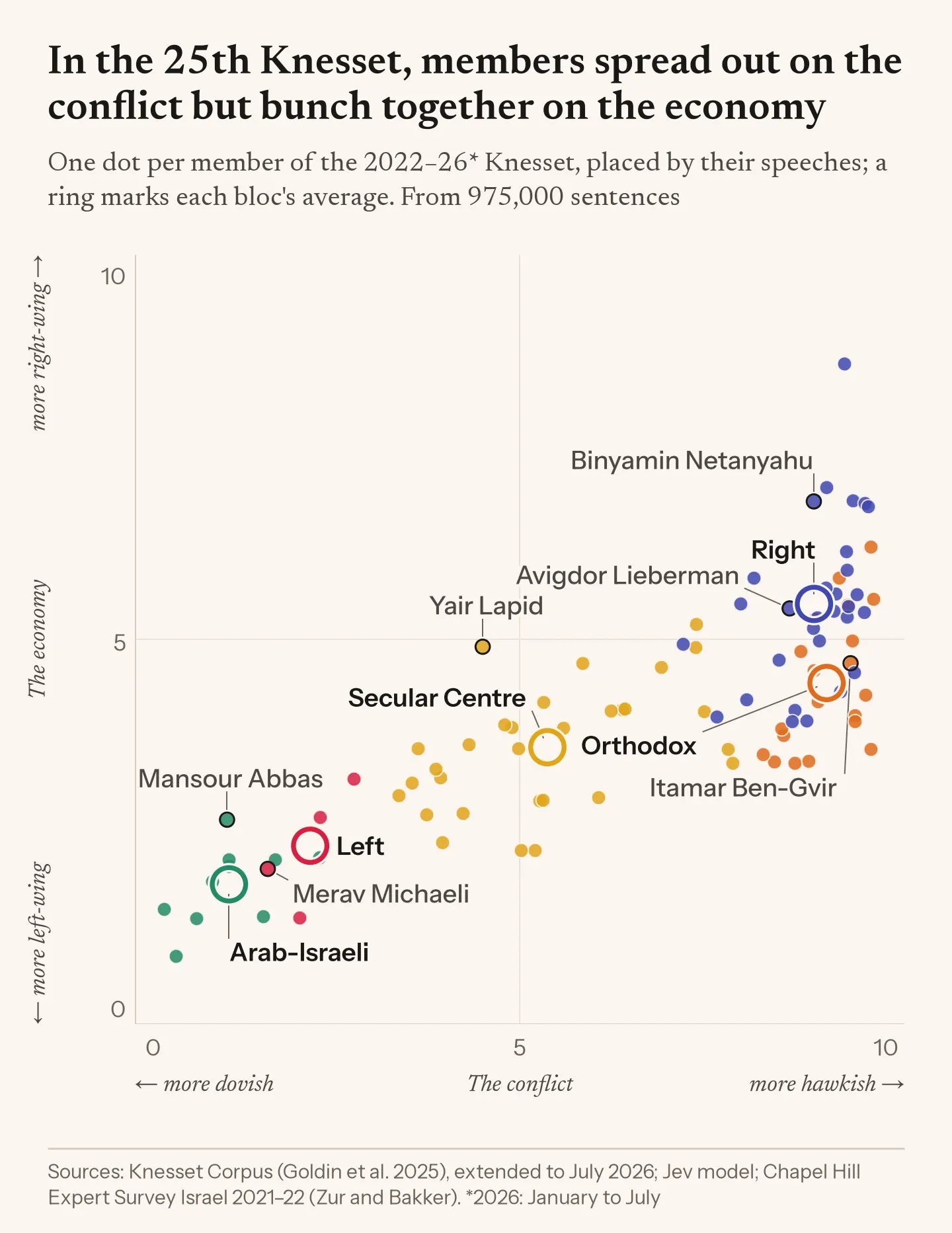
Scatter of the 94 members of the 2022–26 Knesset with enough speech on both scales. Left to right, on the conflict, they run from dovish Arab and Left members near 1, through the Secular Centre around 5, to Right and Orthodox members near 9. Up and down, on the economy, they sit much closer together: the middle 80% of members span 2 to 6, a spread about half as wide.

When the model Jev came out I saw this as an opportunity. This model can process billions of tokens for relatively very little in a small fraction of a second. With some time I pieced together the story of the Knesset, and more widely Israeli politics, over the last thirty years or so.

What Jev found

- The two camps drew together in the Kadima years and are now as far apart as ever. The courts, more than the conflict, drove them apart.
- Voters left their parties more than their camps. Left-wing voters shrank; the Left's seats all but vanished as its voters went to the centre.
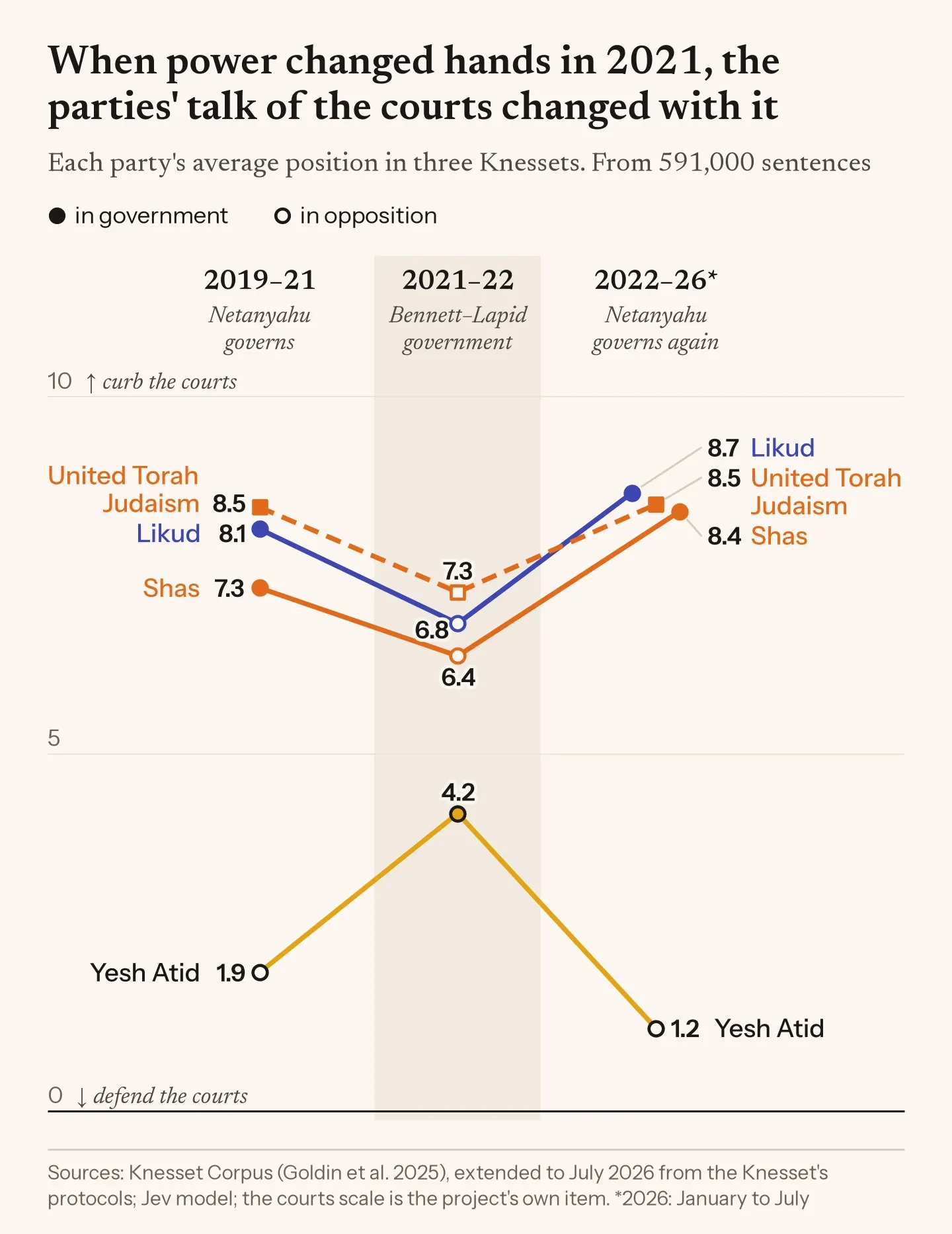
- When power changed hands in 2021, the parties' talk of the courts changed with it.
- Since 2021 the chamber has turned hostile, and the tone is still hardening in 2026.
- After 7 October, security took three plenary speeches in five; in 2026 religion and state took a record share.

The first obvious step was to map the politicians on dimensions established by the Chapel Hill survey, to ensure the model was better than a random number generator. I was pleasantly surprised when the results on most dimensions were highly correlated, with an r value between 0.93 and 0.99 (though weaker on the economy, where Israeli politics has much greater consensus). It holds among the Jewish parties alone, so the model is not just telling the Arab parties apart from the rest.
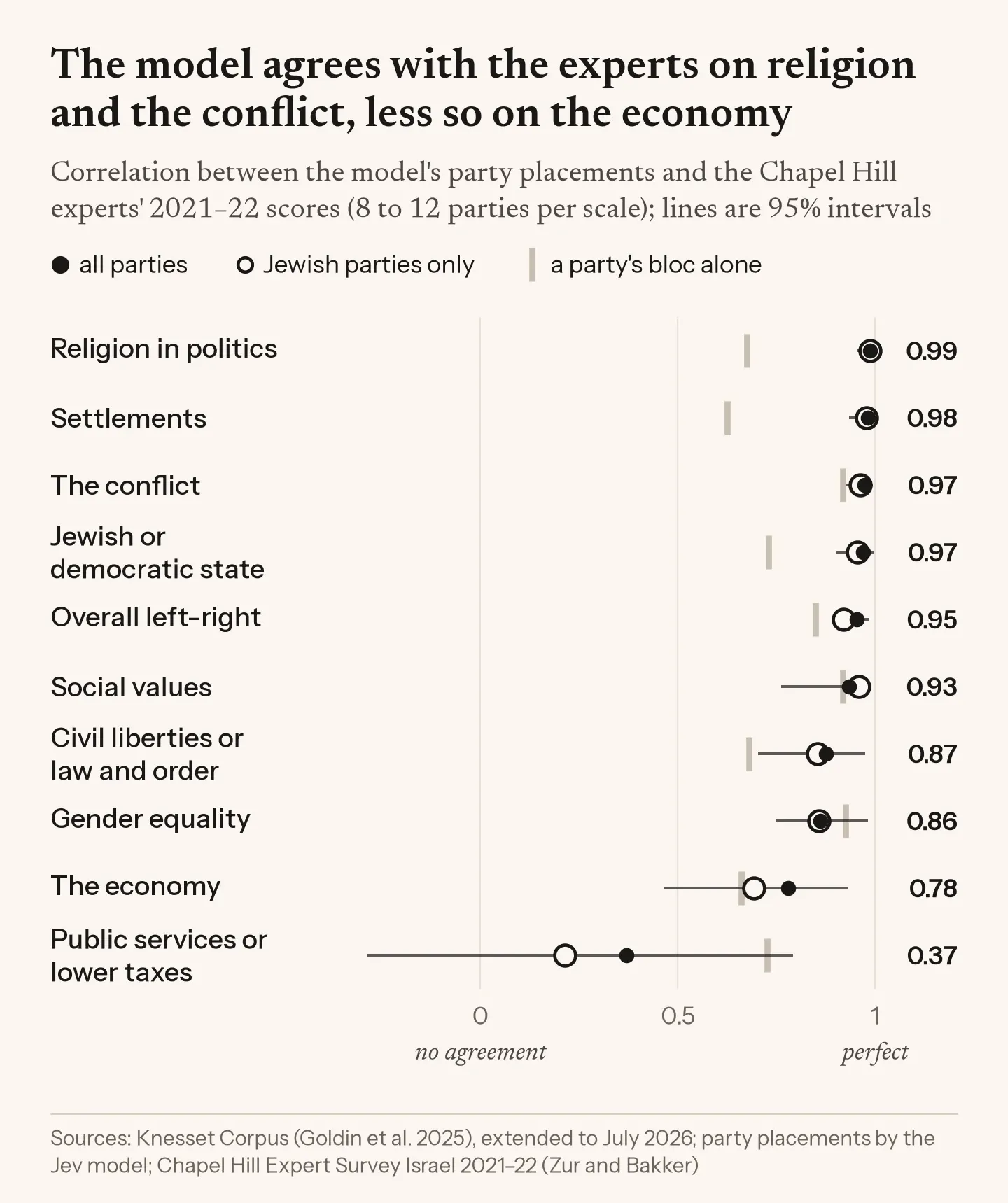
Dot plot of ten scales. The model's party placements correlate with the Chapel Hill experts' at 0.93 to 0.99 on religion, settlements, the conflict, Jewish or democratic state, overall left-right and social values, well above what a party's bloc alone gives on religion (0.68) and settlements (0.63). On the economy the figure is 0.78, and on public services against taxes 0.37, below the bloc alone (0.73); the pattern is much the same among Jewish parties alone.

Next I mapped all the members of the Knesset (MKs) for every Knesset since 1992, around 16 million sentences from the plenary and its committees. I found that the trend we see across the world holds true in Israel too: increased polarisation and political sorting. The two camps drew together in the Kadima years and are now as far apart as ever.

Six rows of dots, one per member, for six Knessets from 1992–96 to 2022–26, placed from left-wing to right-wing. The middle members of the two camps sat 4.9 points apart in 1992–96, 2.4 in 2006–09 and 6.1 in 2022–26, and the red Left dots thin from 59 to 4 by the last row.

Israeli politics dealigns and realigns all at once. It realigns because the courts now divide the chamber more than anything: four in five members sit at one end or the other of the courts scale, against one in seven in the early 1990s, while the conflict has divided members about as much throughout.
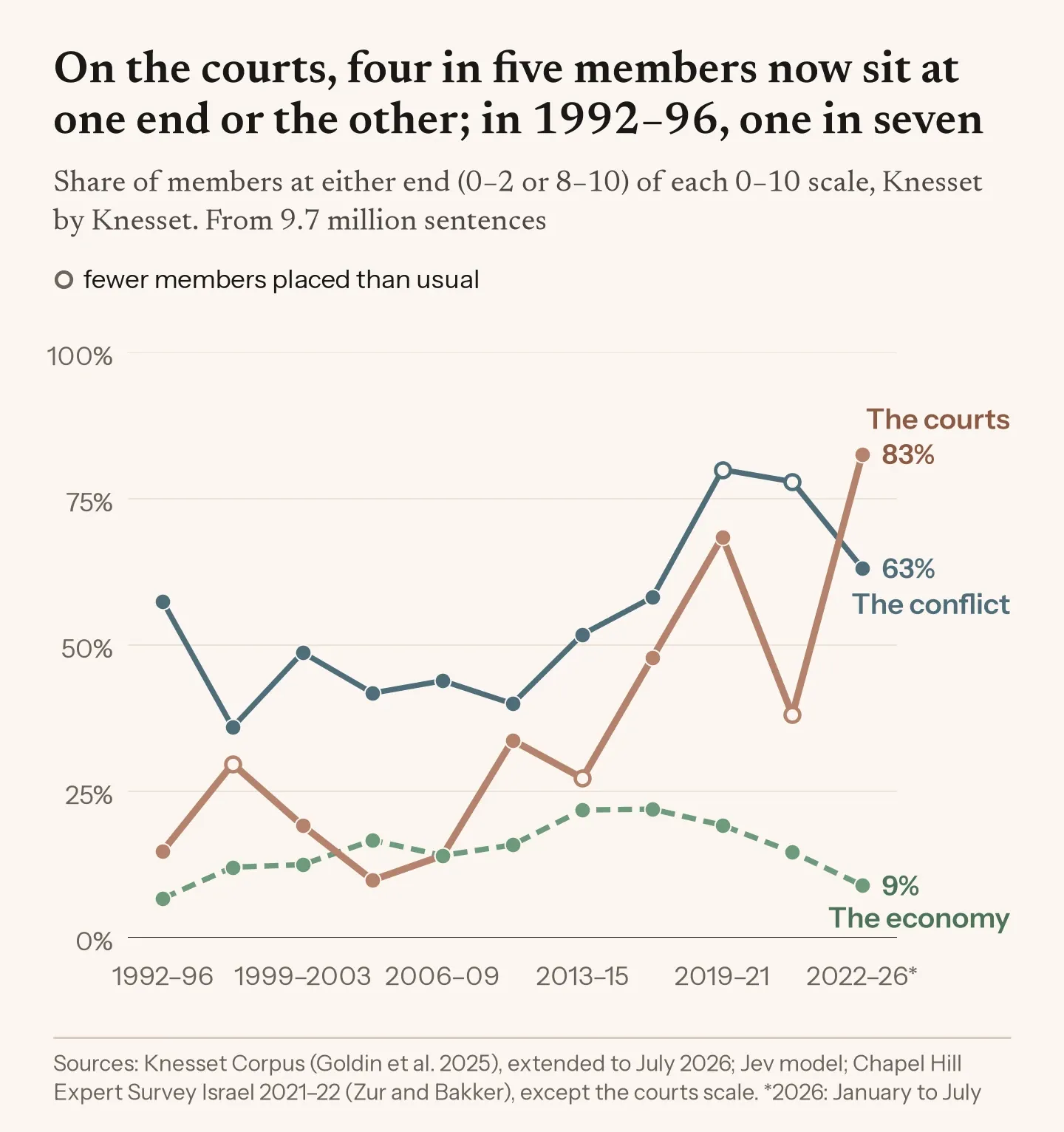
Line chart by Knesset, 1992–96 to 2022–26. The share of members at one end or the other of the courts scale rose from 15% to 83%. On the conflict it was 57% then and 63% now, after a peak of 80% in 2019–21 that rests on fewer members than usual; on the economy it stayed under a quarter throughout.

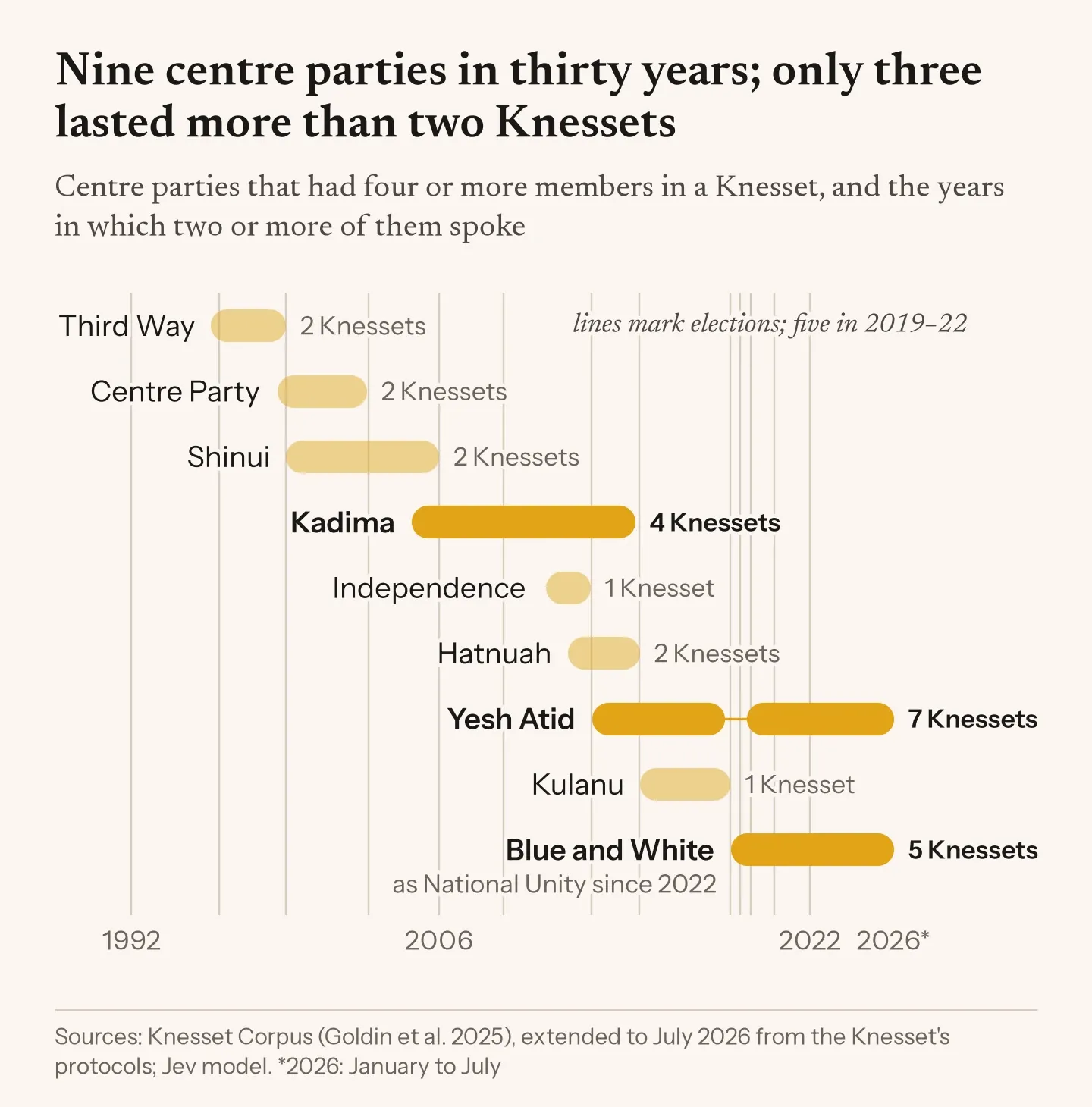
It dealigns in the sense Michal Shamir and her colleagues described: voters' ties to their parties have loosened while the camps hold. At each election about a fifth of the vote moves between parties, often to new ones, but little moves between the two camps. Nine centre parties have come and gone in thirty years, and only three lasted more than two Knessets.
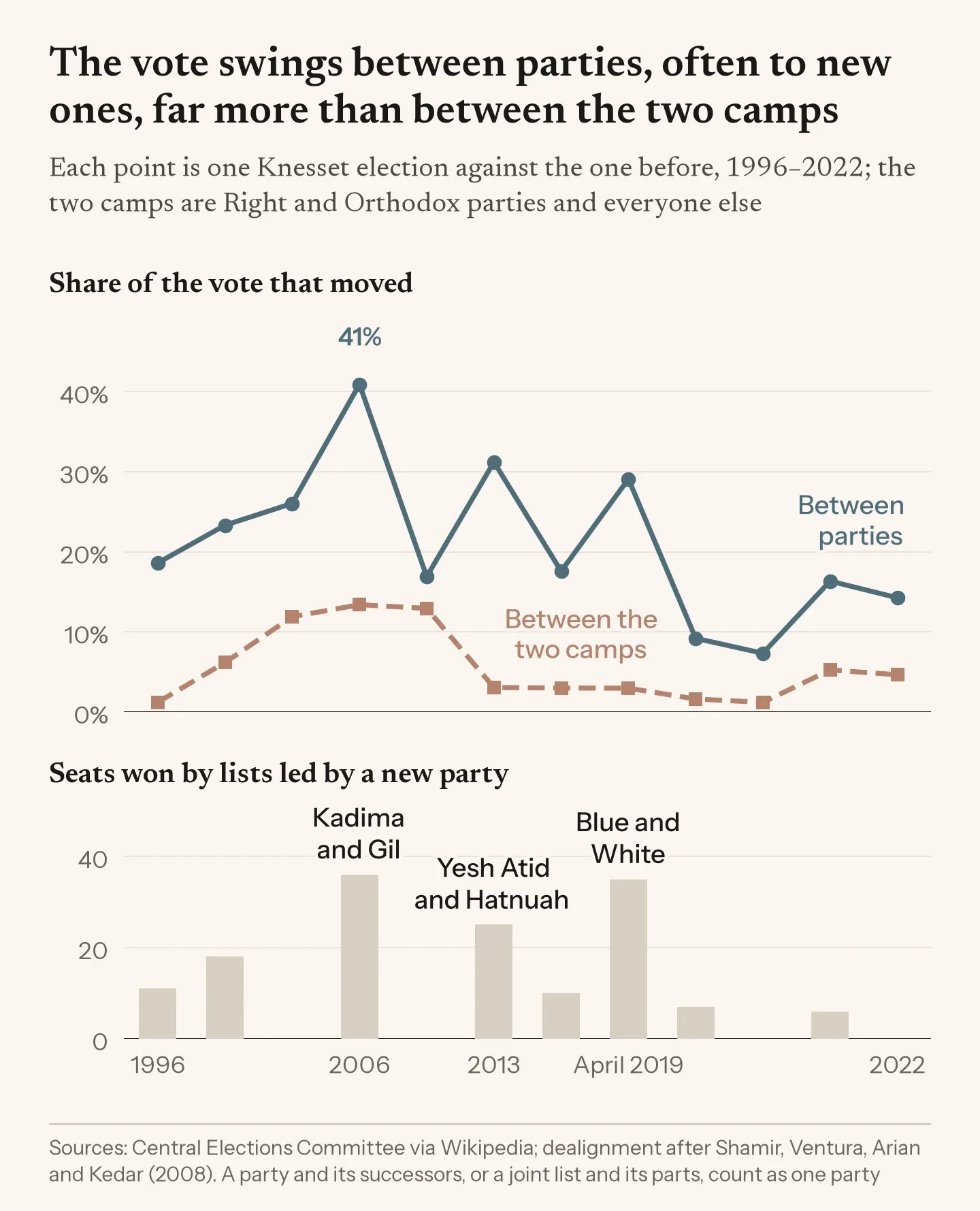
Line and bar chart of the thirteen Knesset elections from 1992 to 2022. At each election a fifth of the vote moved between parties on average (21%, counting a party with its successors and a joint list with its parts), and 41% in 2006, when Kadima and Gil, both new, won 36 seats. Between the two camps, Right and Orthodox against everyone else, only 6% moved on average. New lists also won 25 seats in 2013 (Yesh Atid and Hatnuah) and 35 in April 2019 (Blue and White).
Timeline of nine centre parties, 1992 to 2026. Six (Third Way, Centre Party, Shinui, Independence, Hatnuah and Kulanu) sat for one or two Knessets. Only Kadima (four Knessets, 2005–14), Yesh Atid (seven, 2013 to now) and Blue and White (five, 2019 to now) lasted longer.

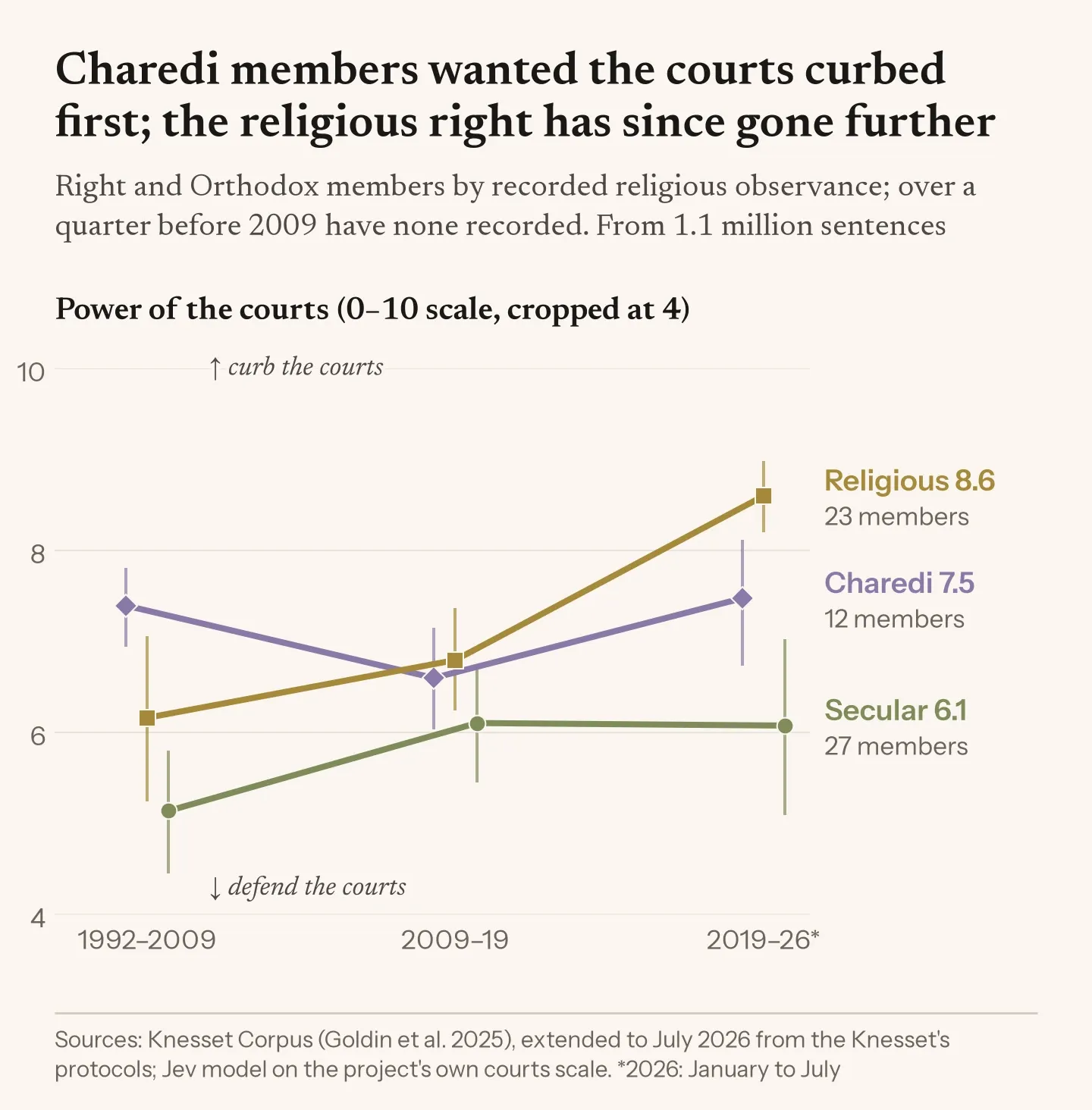
The courts, a symbol of liberal democratic institutions, now divide Israeli society. The Right and Left once sounded alike on them; now they stand at opposite ends. The religious right gained a foothold in Likud (though Likud's secular members moved too), and religious members of the Right have since gone further than even the Charedi members, who wanted the courts curbed first. Power matters as well: when power changed hands in 2021, the parties' talk of the courts changed with it, and changed back when Netanyahu returned.
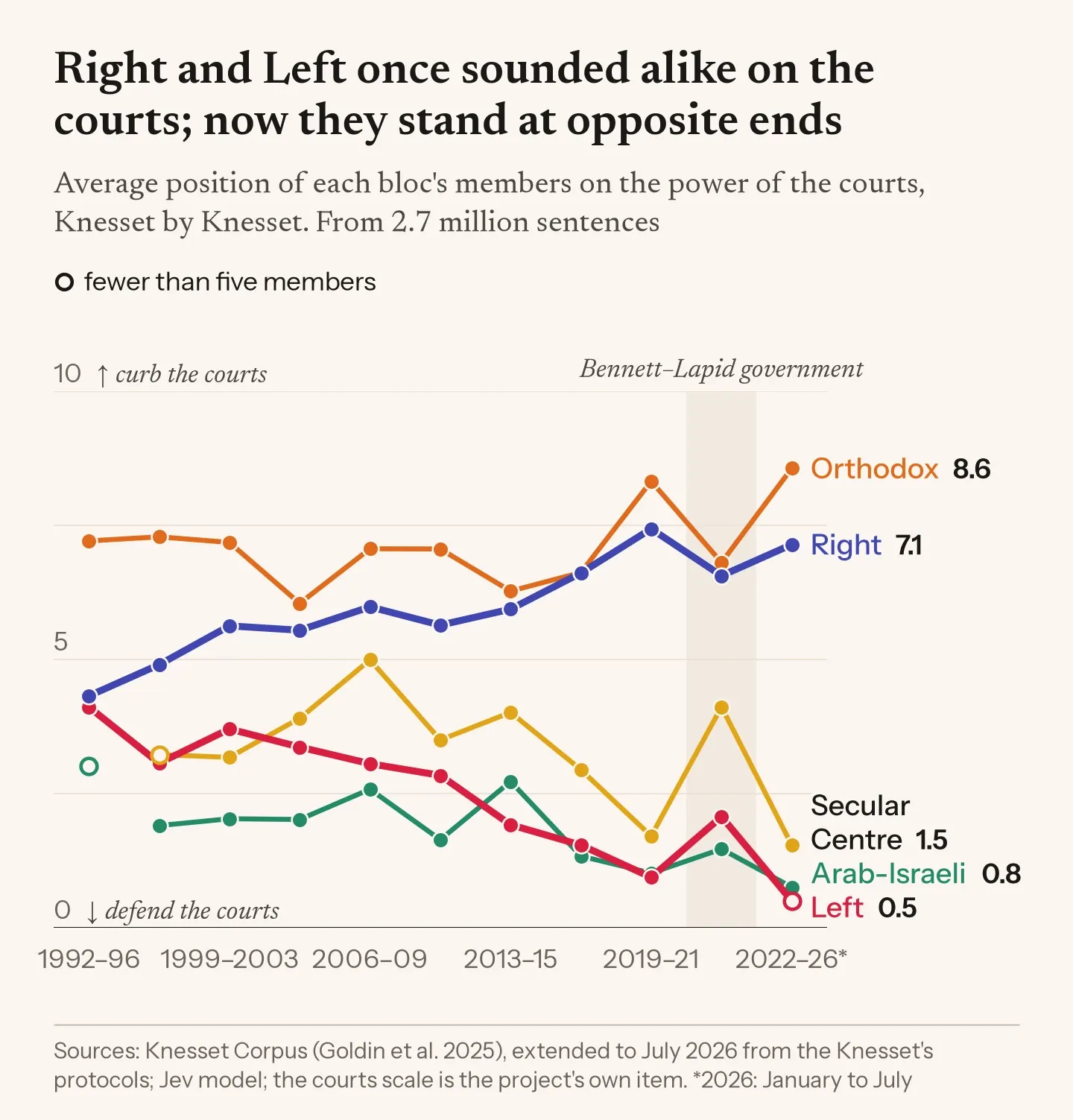
Line chart of the five blocs on the power of the courts, 1992–96 to 2022–26. In 1992–96 the Right (4.3) and the Left (4.1) sat together in the middle, with the Orthodox (7.2) already for curbing the courts. By 2022–26 the Right (7.1) and Orthodox (8.6) are near the top and the Left (0.5), Arab-Israeli (0.8) and Secular Centre (1.5) near the bottom.
Slope chart of Right and Orthodox members on the power of the courts in three eras. Charedi members averaged 7.4 in 1992–2009 and 7.5 in 2019–26. Religious members rose from 6.2 to 8.6, passing them, and secular members rose from 5.1 to 6.1.
Slope chart of four parties across three Knessets. In opposition in 2021–22, Likud fell from 8.1 to 6.8 on the courts scale, Shas from 7.3 to 6.4 and United Torah Judaism from 8.5 to 7.3, while Yesh Atid, in government, rose from 1.9 to 4.2. All four moved back in 2022–26.

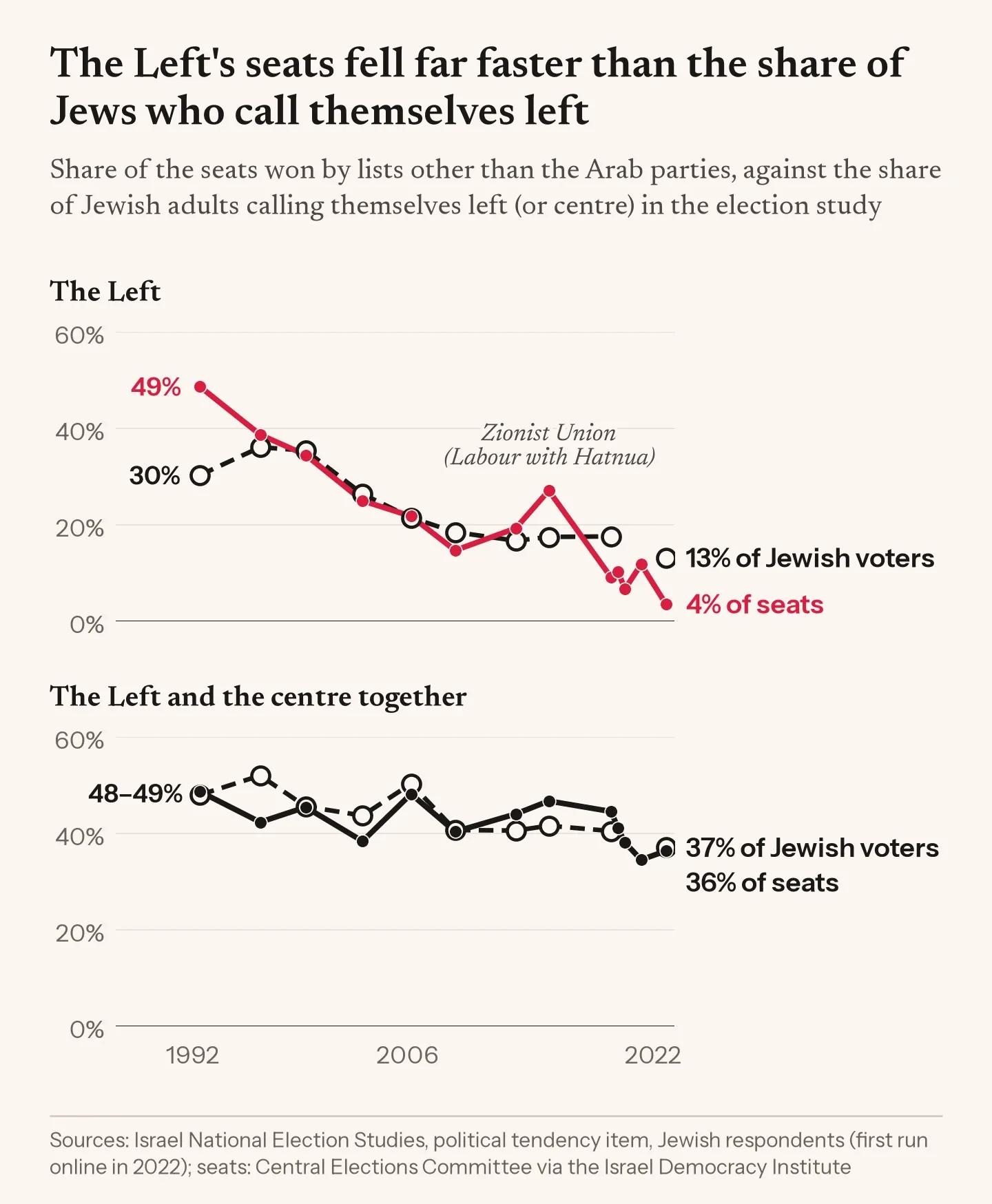
What is also interesting is that you can identify the trends of individual politicians as their political rhetoric shifts with their attitudes. A few leaders moved far, Sharon, Olmert and Livni among them, but most members ended close to where they began, so the chamber moved mostly because of who was elected: composition matters more than conversion. Voters moved too. The share of Jewish Israelis who call themselves left fell from three in ten in 1992 to about one in eight in 2022. But the Left's seats fell much further, from about half of those won by Jewish parties to 4%, as many left-wing voters backed the centre parties instead.
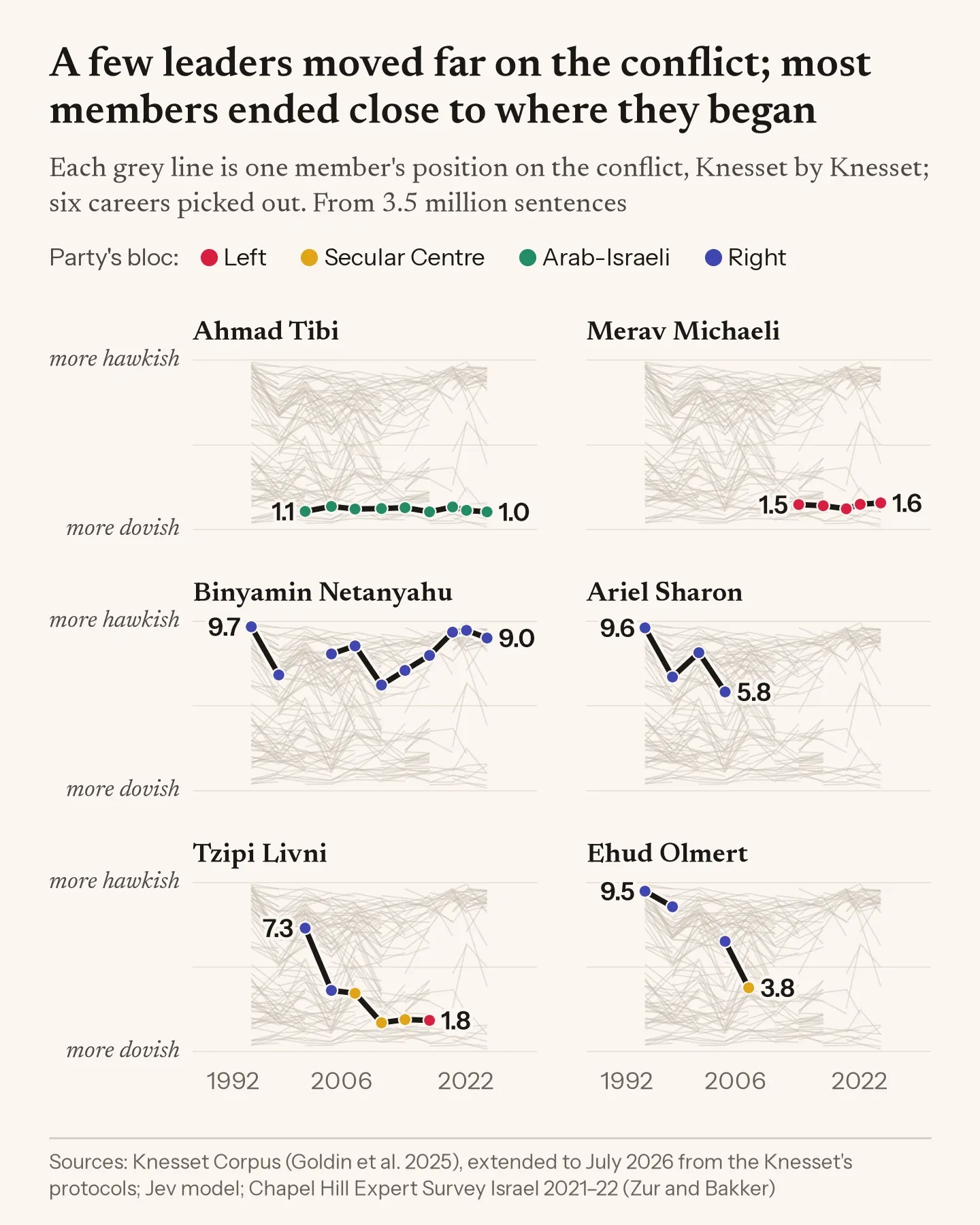
Six small charts, each showing every member's career on the conflict in grey with one member in black: Ariel Sharon falls from 9.6 to 5.8, Tzipi Livni from 7.3 to 1.8 and Ehud Olmert from 9.5 to 3.8 as they leave or split Likud, Binyamin Netanyahu dips from 9.7 to 6.2 and returns to 9.0, and Ahmad Tibi and Merav Michaeli barely move. Most members end close to where they began: about six in seven of those who sat for three or more Knessets finished within two points of their first position.
Two line charts, 1992 to 2022. Top: the share of Jews calling themselves left fell from 30% to 13%, while the Left's share of seats won by lists other than the Arab parties fell from 49% to 4%, breaking away after 2015. Bottom: the Left and centre together won 36% of those seats in 2022, against 37% of Jewish voters who call themselves left or centre.

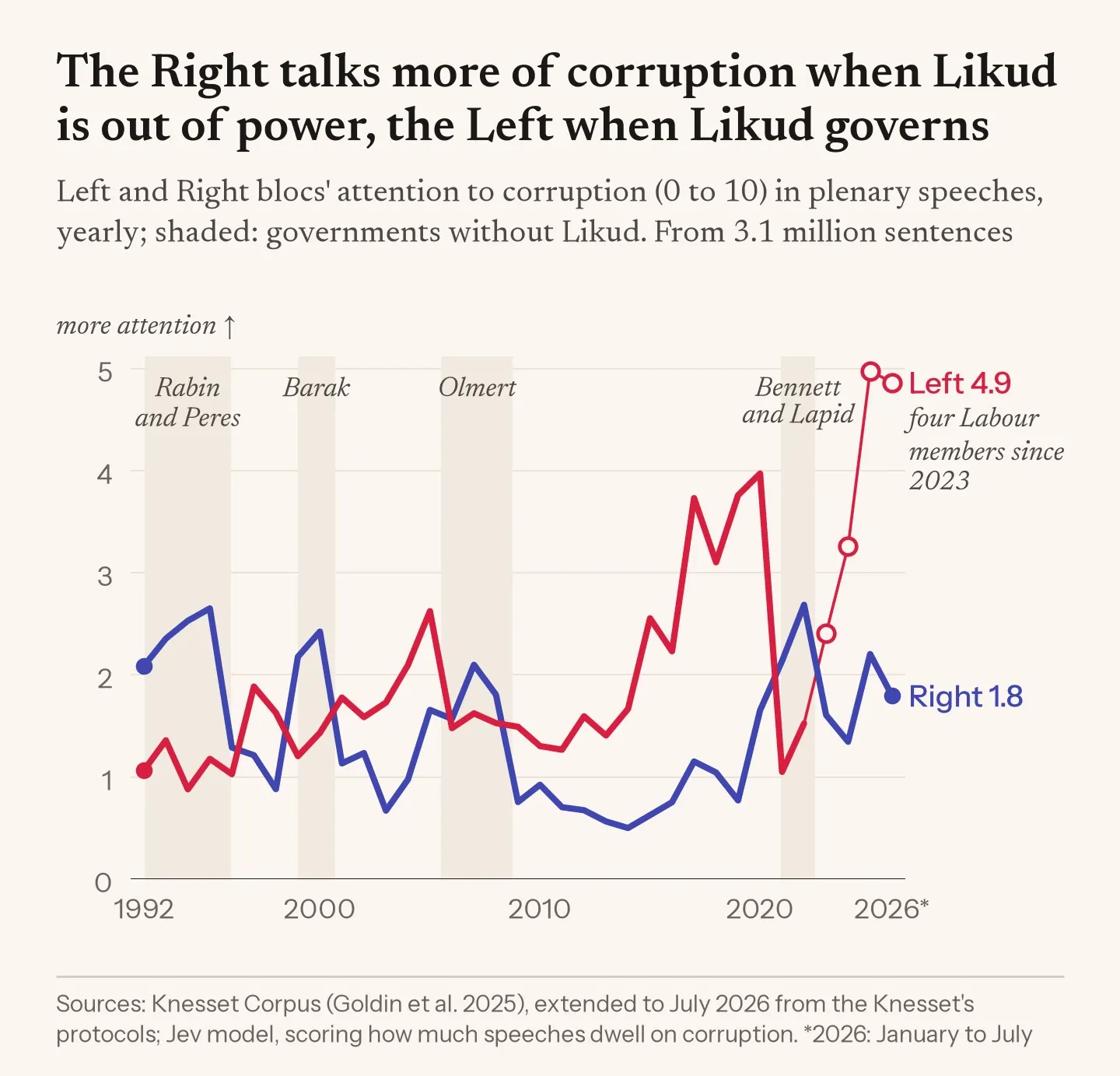
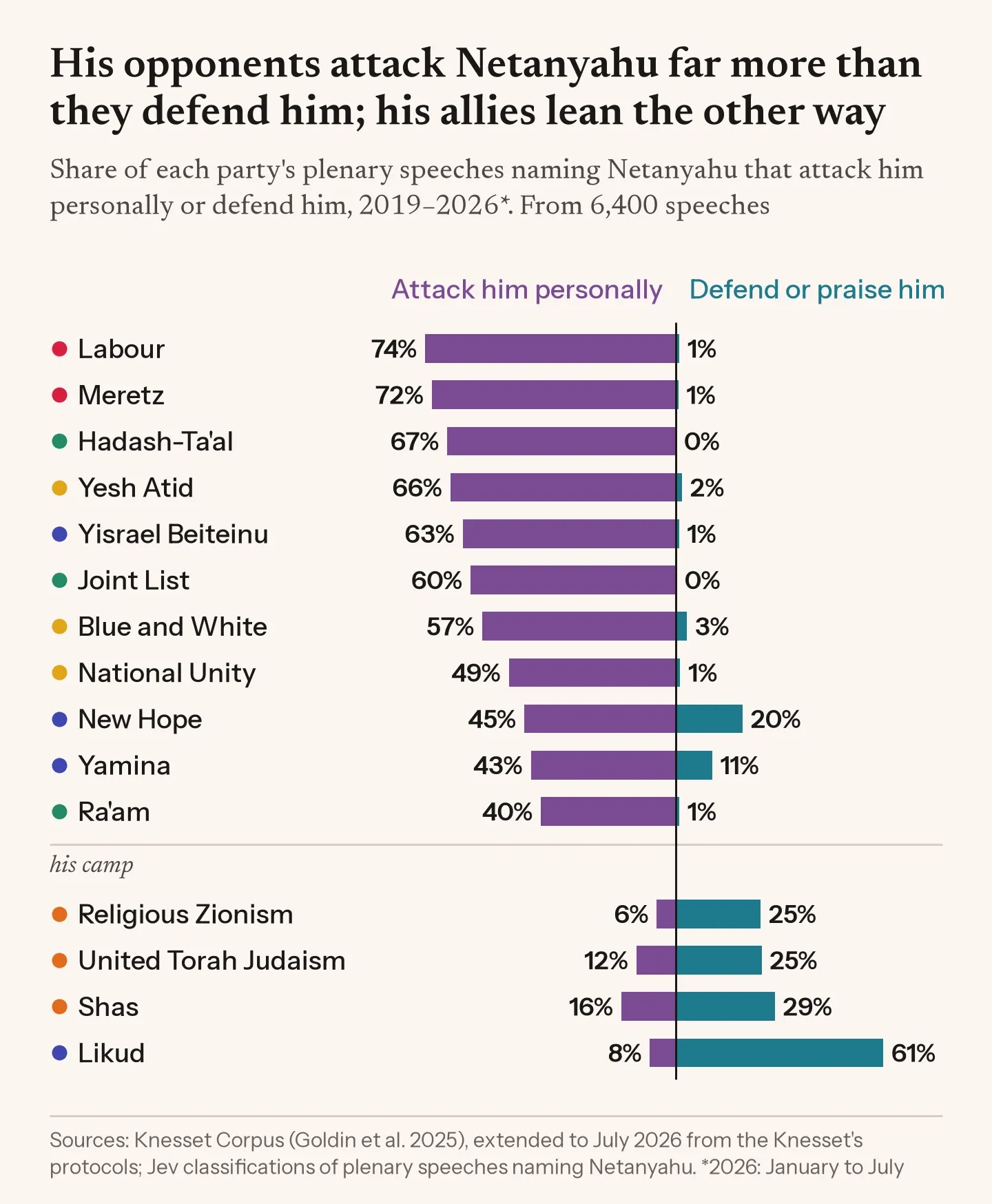
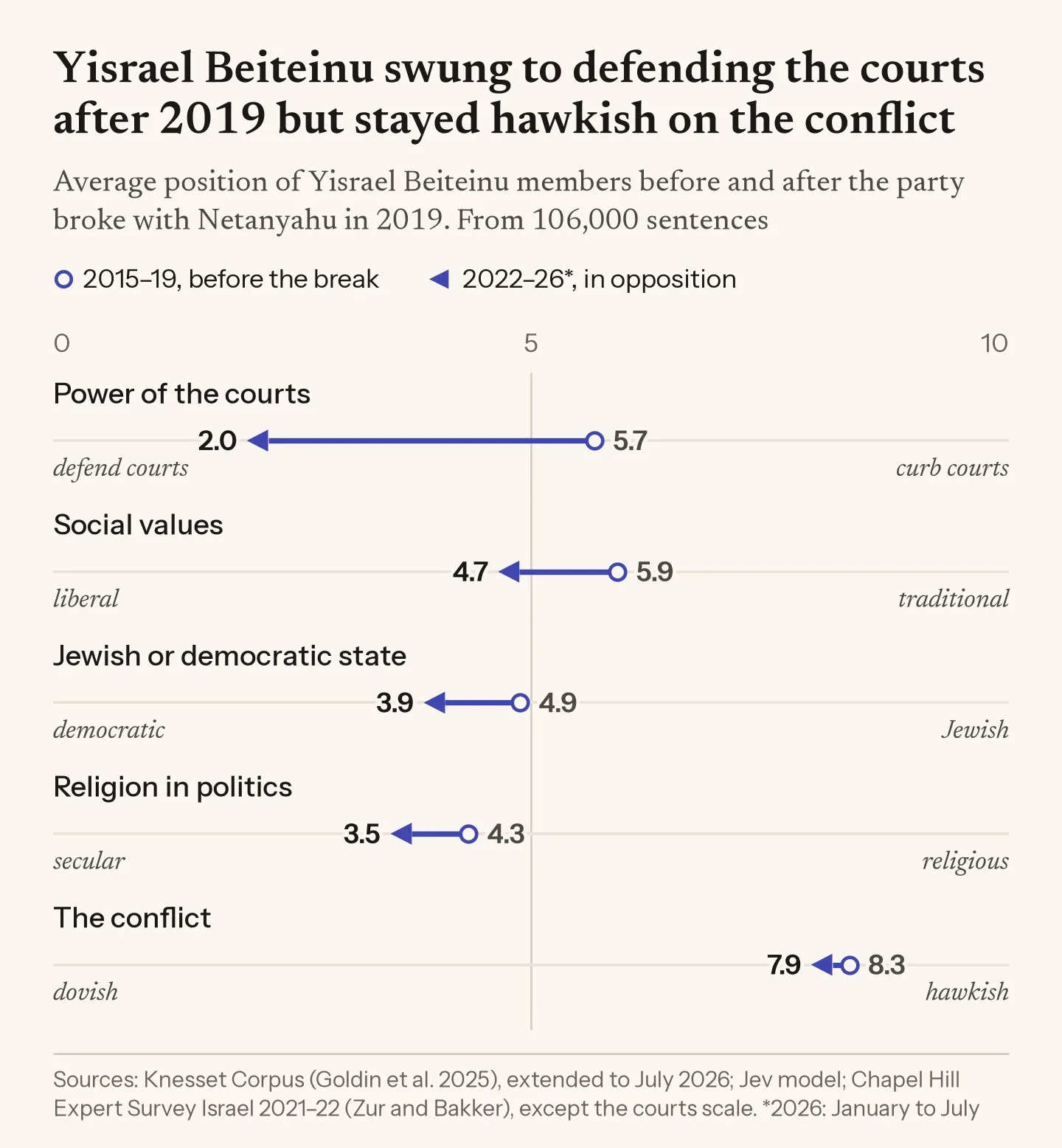
The stories of whole parties and their coalitions are also evident. You can see how Likud turned its back on a proud democratic institution, the Supreme Court. And how Ariel Sharon's efforts to moderate to win over the Jewish middle classes proved only temporary. The collapse of Labour Zionism, and the rise of the secular centre in its place. The change of sides by Yisrael Beiteinu, which swung to defending the courts after it broke with Netanyahu but stayed hawkish on the conflict. The increased focus on issues such as corruption, which each side raises most when the other governs. And Netanyahu himself: his opponents attack him far more than they defend him, and his allies the other way round.
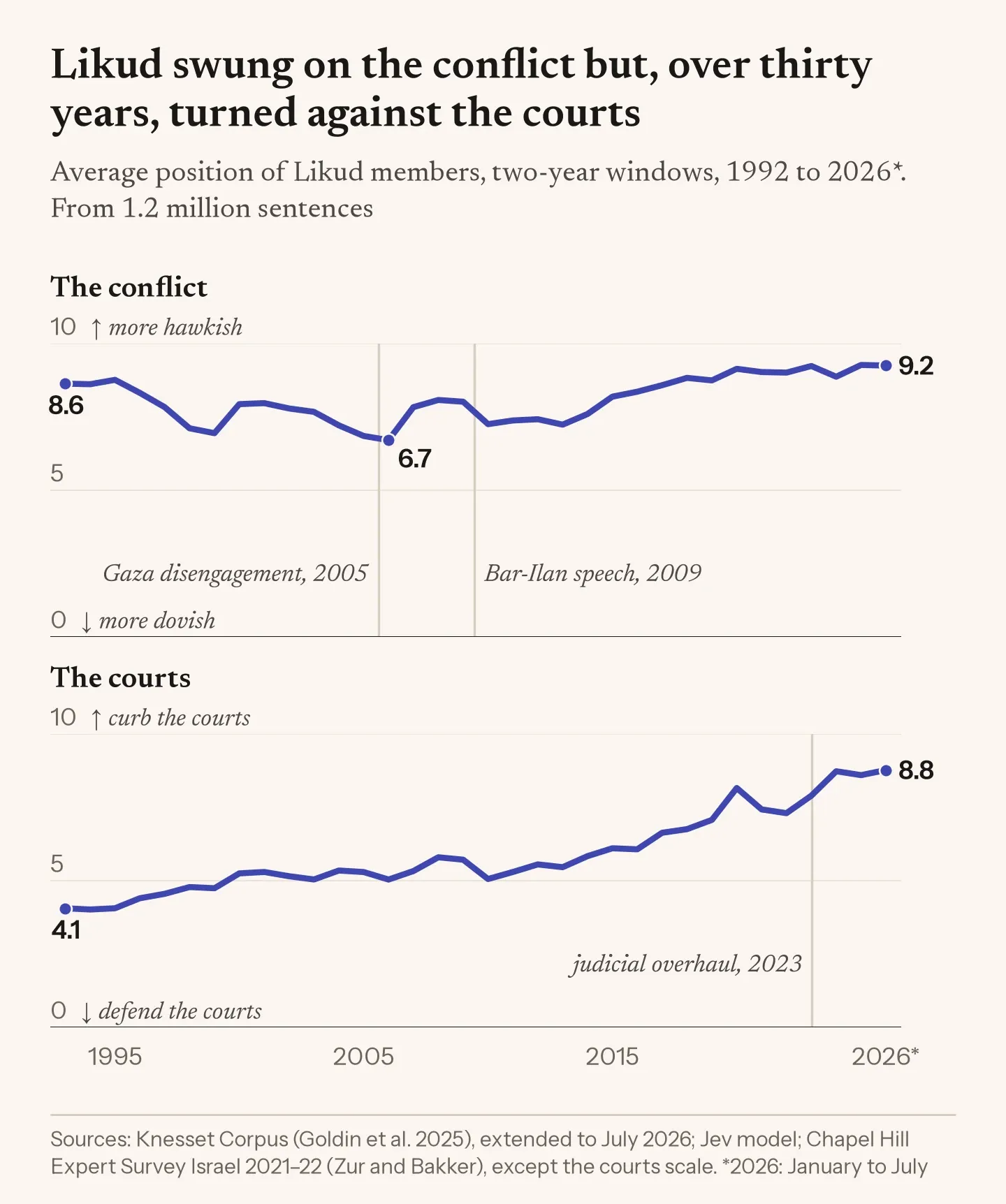
Two line charts of Likud, 1993 to 2026. On the conflict it fell from 8.6 to 6.7 by 2006, the disengagement era, and climbed back to 9.2. On the courts it rose from 4.1 to 8.8, with only brief dips.
Arrow chart of Yisrael Beiteinu on five scales, 2015–19 against 2022–26. After breaking with Netanyahu it swung from 5.7 to 2.0 on the courts, towards defending them, but stayed hawkish on the conflict (8.3 to 7.9); on religion, the Jewish or democratic state and social values it moved 0.8 to 1.2 points towards the liberal end.
Line chart of the Left and Right blocs' attention to corruption, 1992 to 2026. The Right talks about it more in the four periods when Likud was out of government (1992–96, 1999–2001, 2006–09, 2021–22), and the Left the rest of the time. Since 2023 the Left is Labour's four members alone, at about 5 in 2025–26 against the Right's 2.
Diverging bars for 15 parties' plenary speeches naming Netanyahu, 2019 to 2026. Parties outside his camp attack him personally far more often than they defend him (Labour in 74% of such speeches against 1%). Inside it, Likud defends him in 61% and attacks him in 8%, while Religious Zionism, United Torah Judaism and Shas defend him in 25% to 29% and leave most mentions neutral.

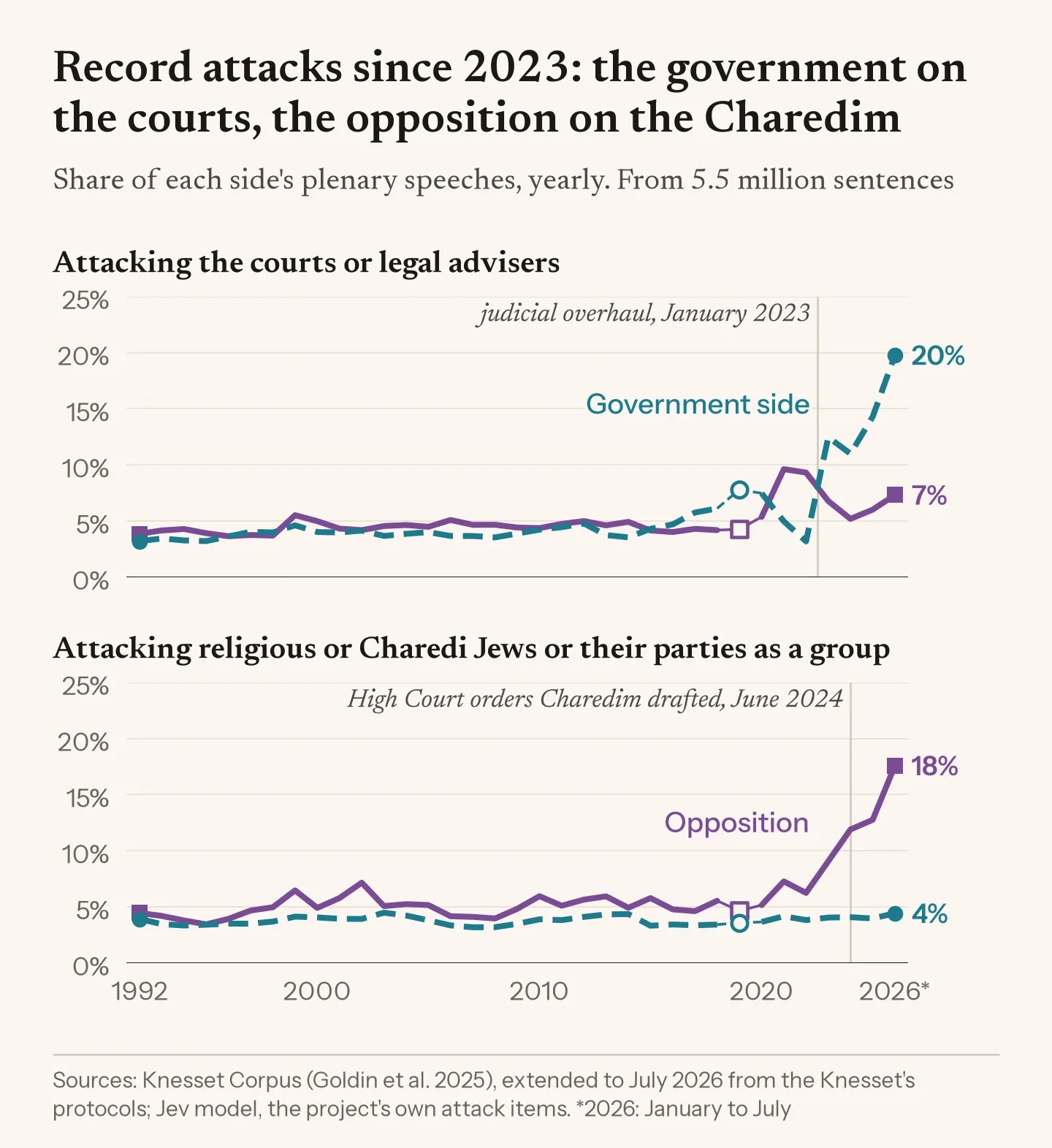
Knesset members have also become angrier, more divided and more hostile to one another since 2021, after hostility and delegitimisation had been flat for 30 years, and the tone was still hardening in 2026. It is not just new faces: the 98 members who spoke both before and after 2021 grew harsher too. And since 2023 the government side has attacked the courts, and the opposition the Charedim, at record rates.
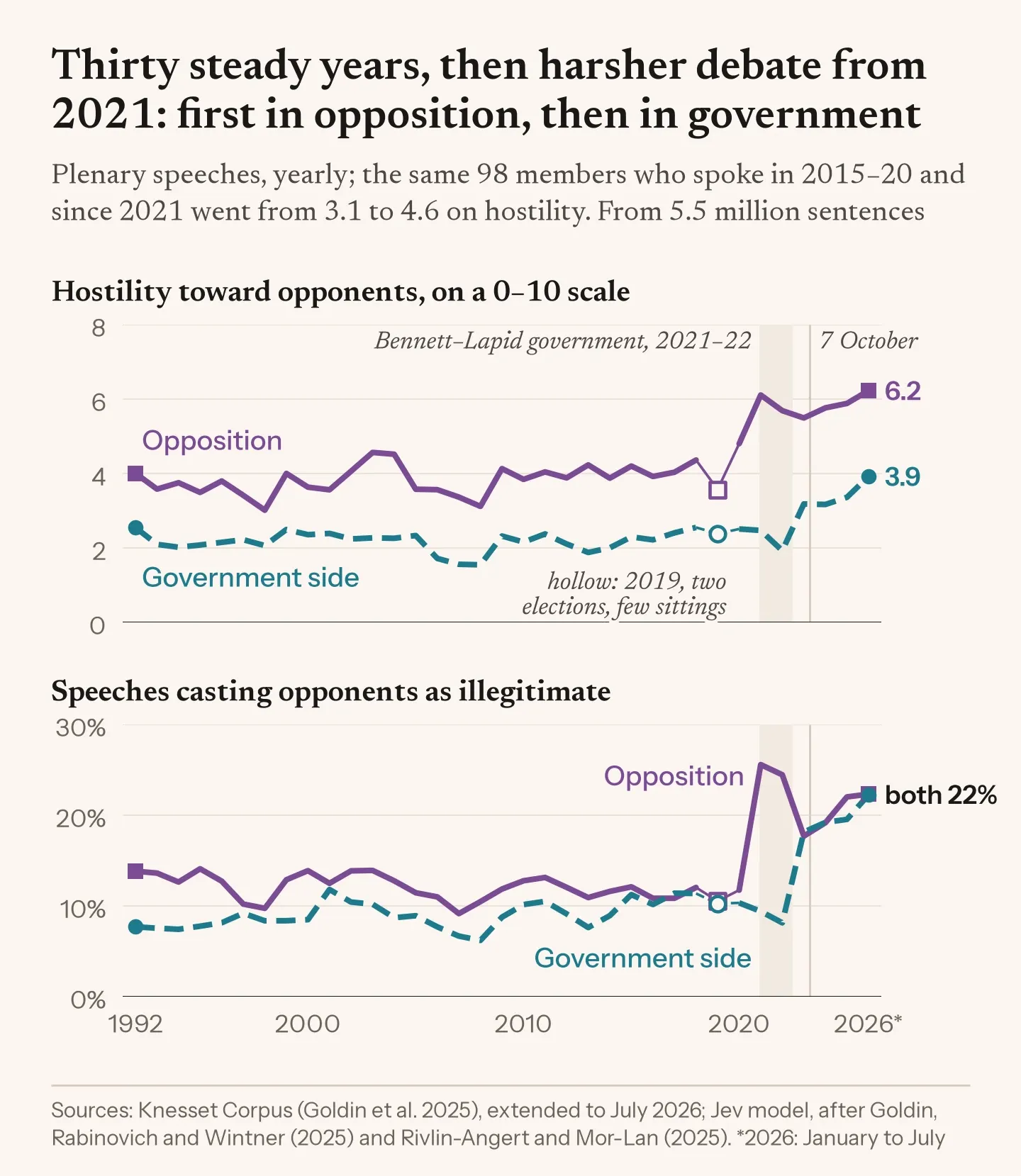
Two line charts, 1992 to 2026. Opposition hostility toward opponents ran between 3.0 and 4.8 until 2020 and 5.5 to 6.2 since 2021; on the government side it ran between 1.5 and 2.5 until 2022 and 3.2 to 3.9 since 2023. The share of speeches casting opponents as illegitimate rose from about one in ten to about one in five on both sides.
Two line charts, 1992 to 2026. Government-side speeches attacking the courts or legal advisers ran at 3–8% until 2022 and 11–20% since 2023. Opposition speeches attacking religious or Charedi Jews or their parties as a group ran at 3–7% until 2022 and rose to 18% in January to July 2026.

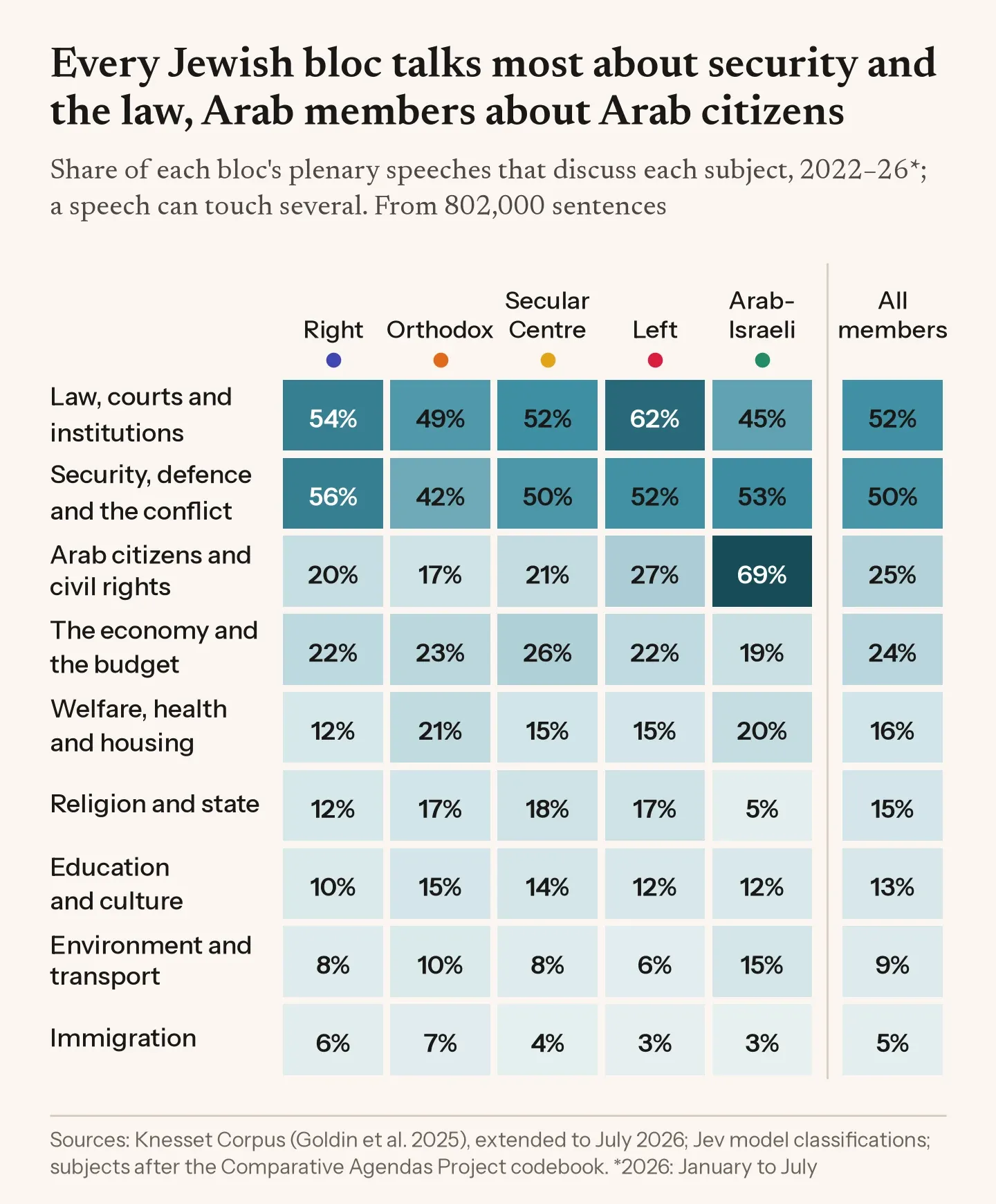
You can look at what is discussed most, and how the security agenda continues to dominate Israeli politics, especially since October the 7th: security took three plenary speeches in five in 2024, twice its usual share. In the months before this election, as the fight over drafting Charedim came to a head, religion and state took a record share too. Every Jewish bloc talks most about security and the law; Arab members talk most about Arab citizens and their rights.
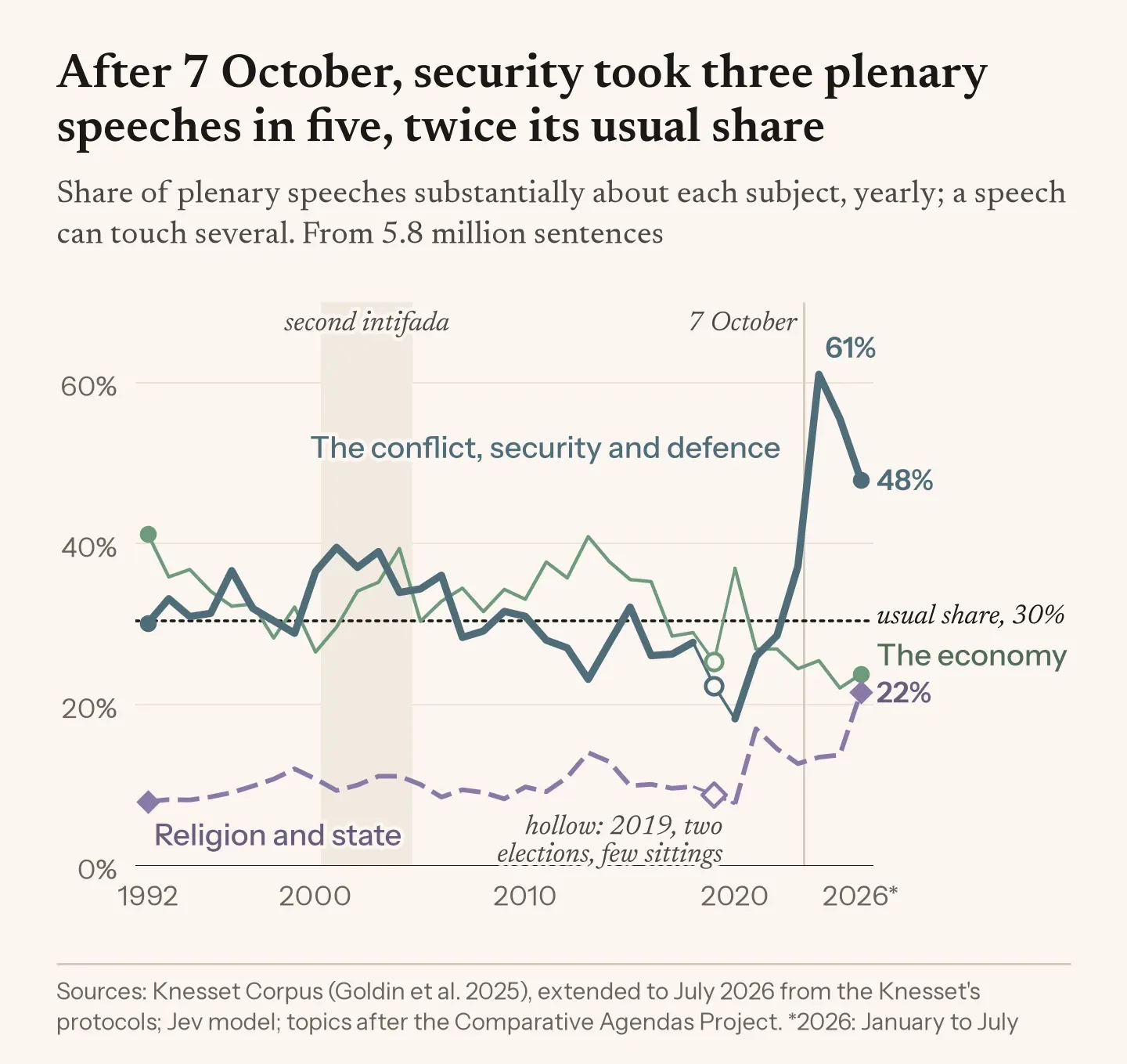
Line chart, 1992 to 2026. The share of plenary speeches about the conflict, security or defence averaged 30% from 1992 to 2022 and never passed 40%, a high reached in 2001 during the second intifada. It reached 61% in 2024, 56% in 2025 and 48% in January to July 2026, while the economy's share fell to about a quarter. Religion and state reached a record 22% in January to July 2026, above its previous high of 17% in 2021.
Table of the nine subjects of plenary speech by bloc, 2022 to 2026. Every Jewish bloc talked most about law, the courts and institutions (49–62%) and security (42–56%). Arab members spoke most about Arab citizens, minorities and civil rights, in 69% of their speeches against 25% for the whole chamber.

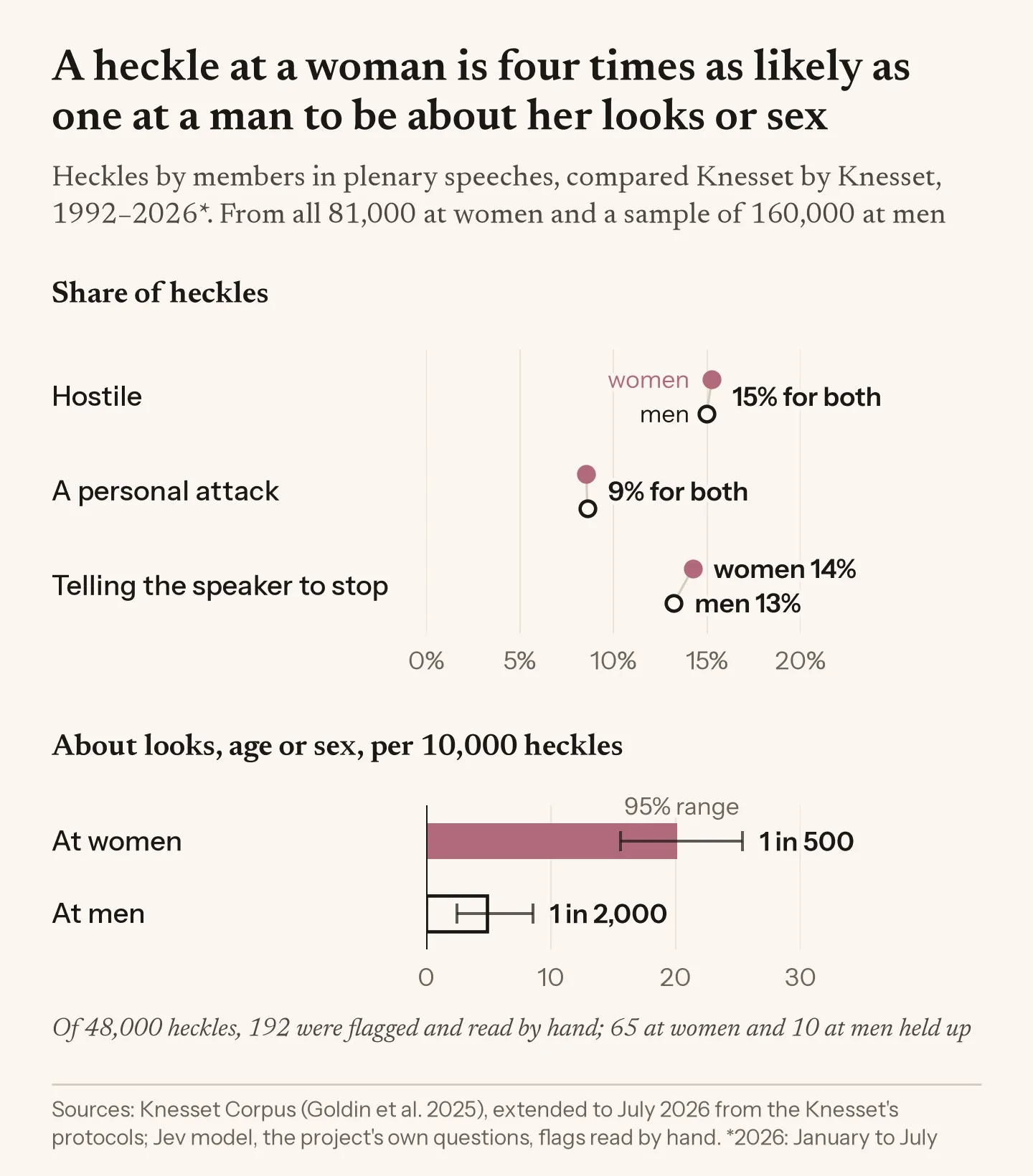
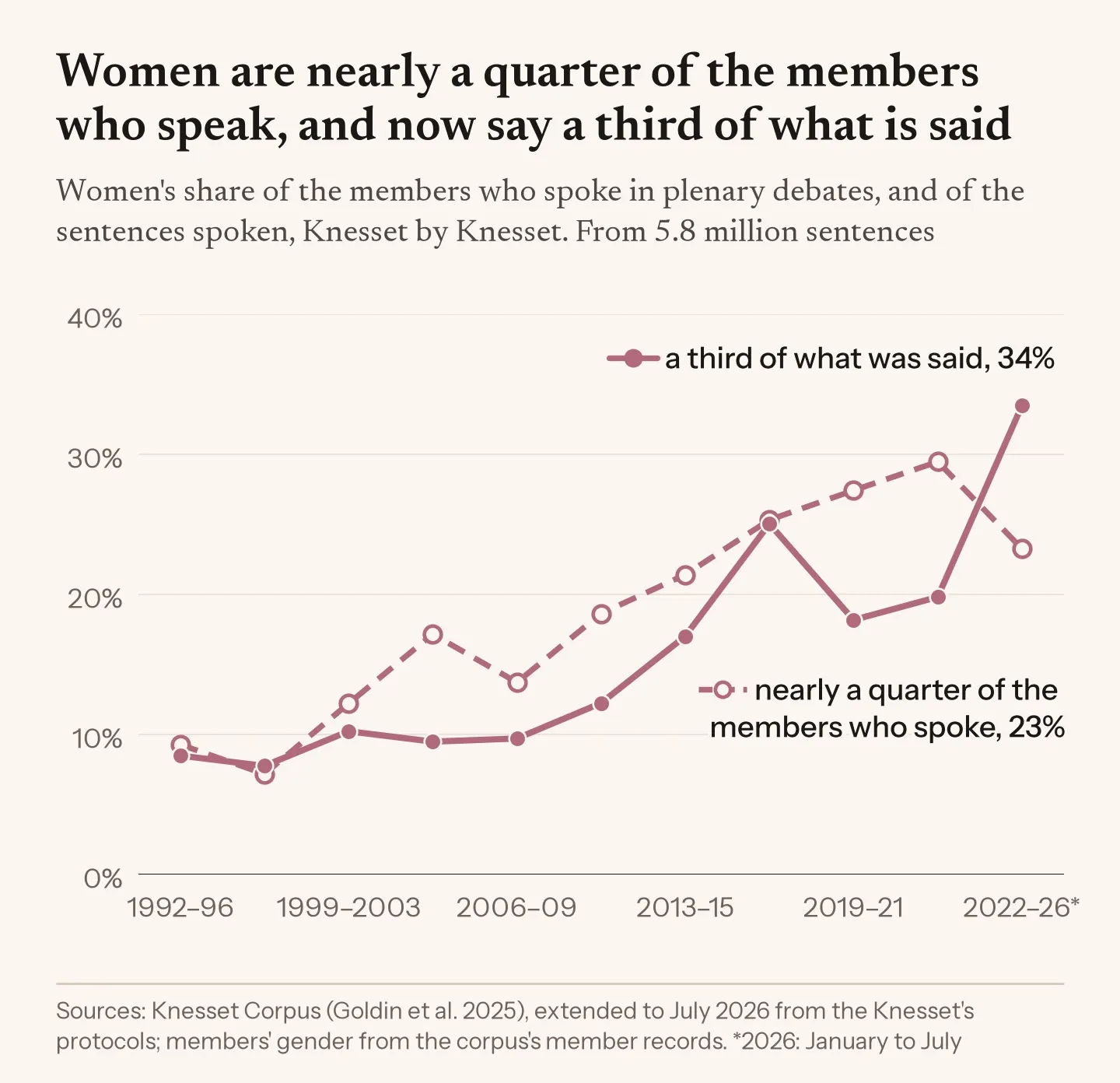
You can also split by other variables: religion, gender, ethnicity and institution among them. The televised debates in the Knesset plenary are more polarised and less cordial than the committees behind the legislation. Women are now nearly a quarter of the members who speak, and say a third of what is said. And a heckle at a woman is four times as likely as one at a man to be about her looks or sex.
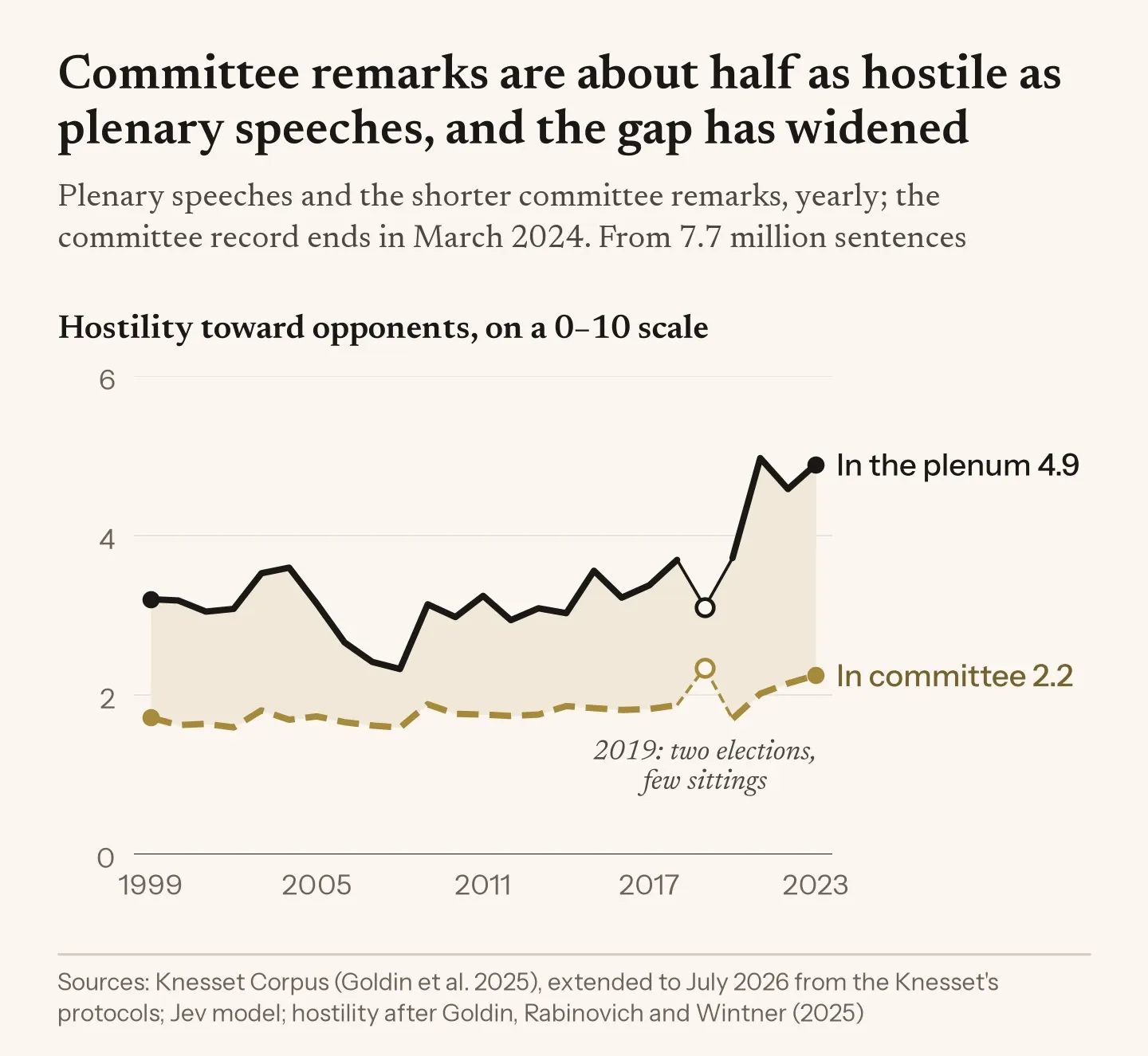
Line chart, 1999 to 2023. Hostility in committee stayed between 1.6 and 2.3, while in the plenum it rose from 3.2 to 4.9, most of it after 2020. Committee remarks, which are shorter, are about half as hostile as plenary speeches on average.
Line chart by Knesset, 1992–96 to 2022–26. Women rose from 9% to 23% of the members who spoke in plenary debates (29% in 2021–22). Their share of the sentences spoken rose from 9% to 34%.
Chart of heckles in the plenum, 1992 to 2026. A heckle at a woman is about 4 times as likely as one at a man to be about her looks, age or sex: about 20 in every 10,000 heckles at women against 5 at men. All 192 flagged cases were read by hand, and 65 at women and 10 at men held up. The top panel shows the shares of hostile heckles, personal attacks and calls to stop for each.

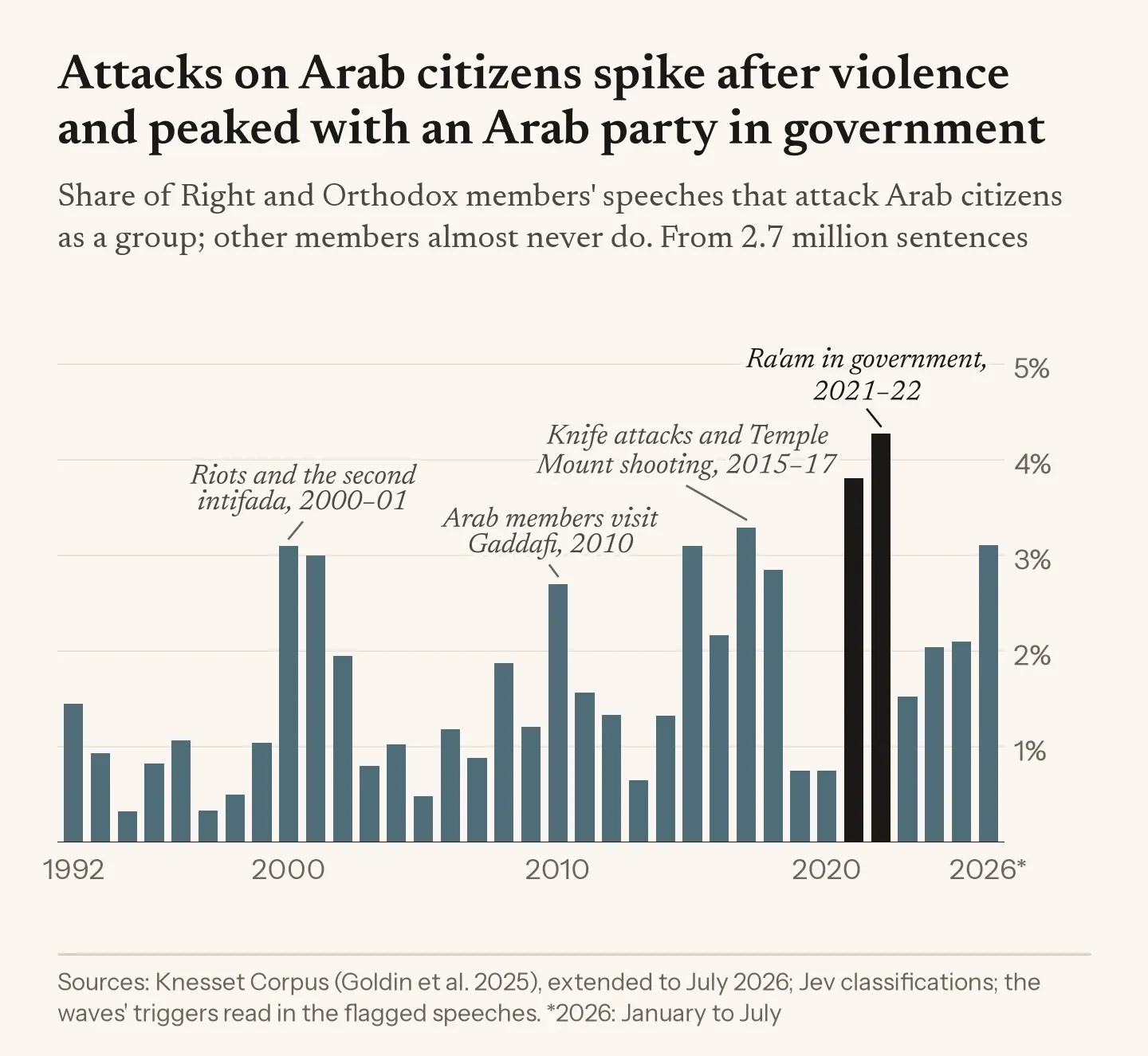
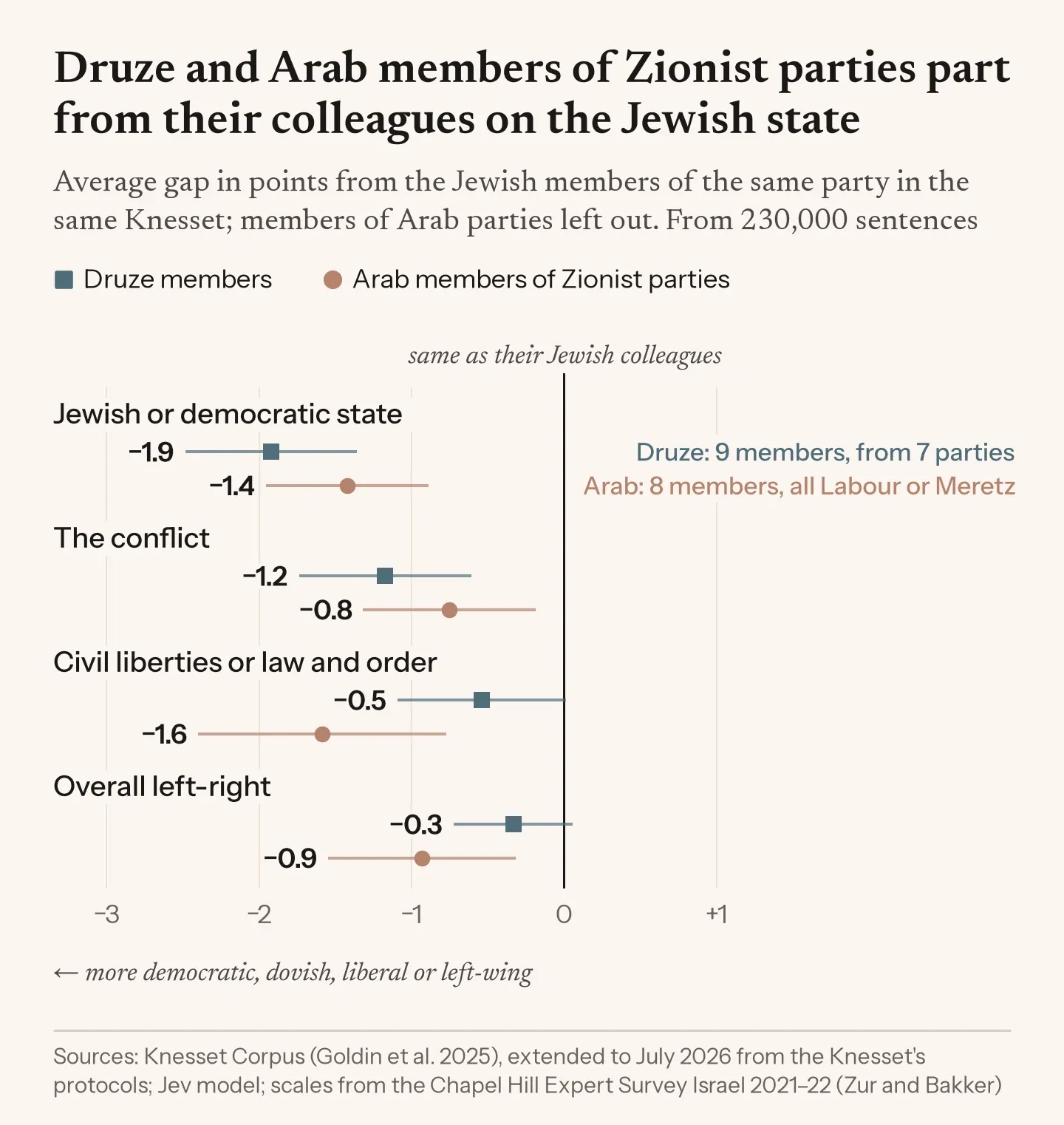
And for both Arab-Israelis and Jewish-Israelis, ethnicity and religion play a pivotal role in their politics. Labour now sits close to the Arab parties on almost every scale, while Ra'am parts from both on religion and social values. Druze and Arab members of Zionist parties part from their Jewish colleagues on the Jewish character of the state. And attacks on Arab citizens as a group, almost all from the Right and the Orthodox, come in waves after violence, and were highest when an Arab party, Ra'am, sat in the government.
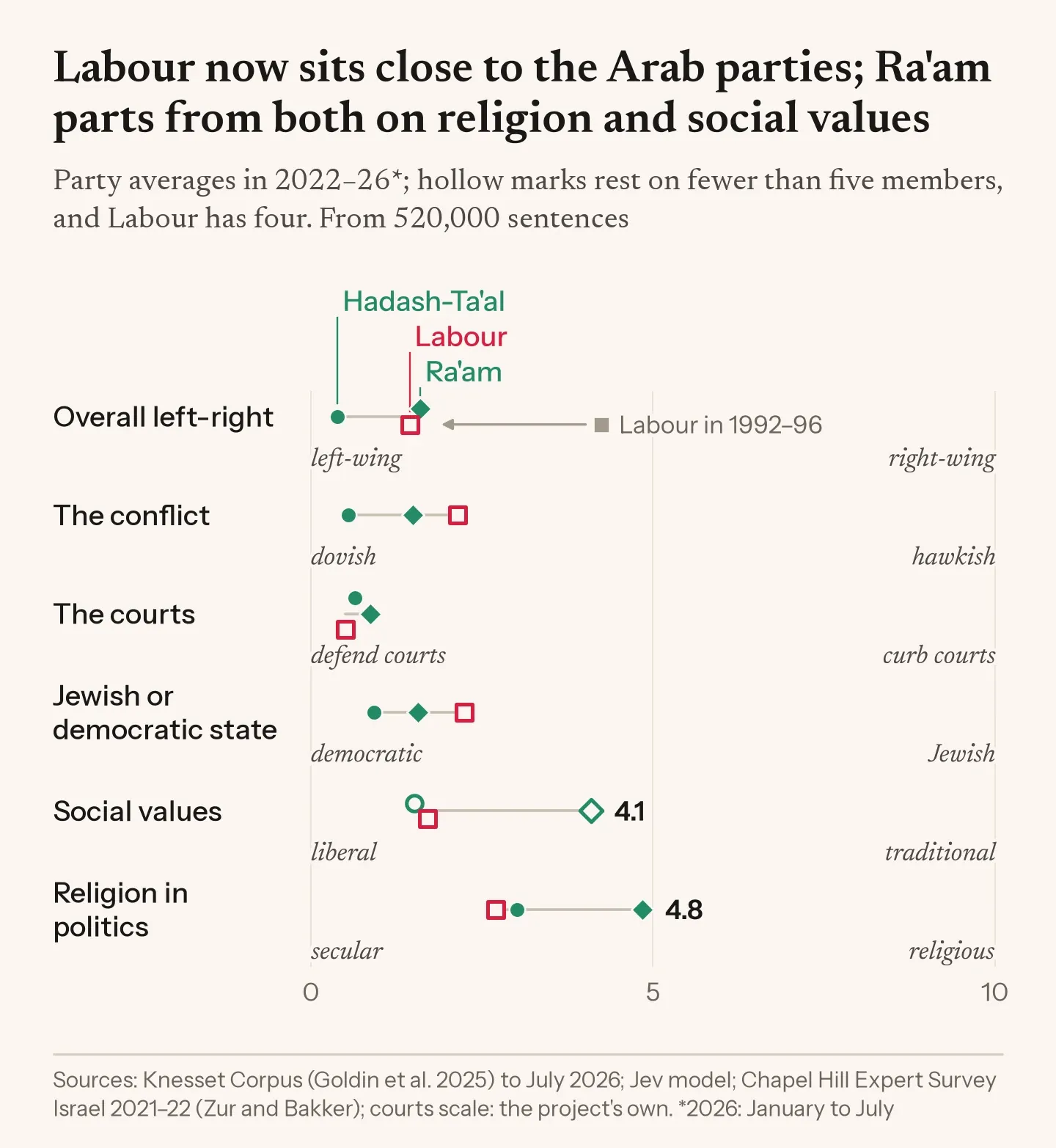
Dot plot of three parties on six scales in the 2022–26 Knesset. Labour, at 4.2 on left-right in 1992–96 and 1.4 now, sits within about one and a half points of Hadash-Ta'al on every scale. Ra'am sits with both on the conflict and the courts but reaches 4.8 on religion and 4.1 on social values (the latter from only three members), against 1.5 to 3.0 for the other two.
Dot chart of how Druze and Arab members of Zionist parties differ from Jewish members of the same party. On Jewish or democratic state, Druze members sit 1.9 points further towards democratic (17 of 17 cases) and Arab members of Zionist parties (all Labour or Meretz) 1.4 points (10 of 11). On overall left-right the gaps are smaller, 0.3 and 0.9.
Bar chart, 1992 to 2026. Speeches attacking Arab citizens, Arab members or Arab parties as a group come almost only from Right and Orthodox members: about 1% of their speeches in a typical year. It rises in waves: 3% in 2000 (the October riots and the second intifada), 3% in 2010 (Arab members' visit to Gaddafi), 3% in 2017 (knife attacks and the Temple Mount shooting), and a peak of 4.3% in 2022, when Ra'am sat in the government. Other members' speeches: 0.1%.

What this tells us is that the future of machine learning and text analysis (soon to be multimodal) looks very bright for academics and researchers of all kinds! The code is available here, for those curious.

Jev-Knesset
Code, prompts and data for An LLM's take on Israeli politics

Shana Tova! And if you are Israeli, please vote on the 27th of October! If you know any Israelis, do your duty to nag them until they plan to go to the polling booth. The stakes couldn't be higher for democracy, for the hope of peace, and for the freedom and security of all people, Israeli and Palestinian.

Hold on... there’s more